
























Wollmatten: Benefits, Uses & Buying Guide

Wollmatten always capture my attention. Natural insulation materials usually require a bit more thought to understand their utility. Wool keeps sheep warm, so why not use it to keep buildings warm as well? Woolmatten is surprisingly logical. The challenges of constructing a wool-insulated building probably go beyond covering the building in a gigantic sweater.
What I find appealing about wool insulation is its ability to interact with vapor and sound, as well as fit into small spaces. Wool also has a high resistance to flame.
When evaluating the potential use of insulation materials, there are a number of factors that must be taken into account, including performance, cost, how easily it can be installed, its weight and bulk, pest control, and its effect on a building’s behavior. Based on all of these factors, the use of wool insulation must be weighed on a case-by-case basis, considering the pros and cons for each use.
What Are Wollmatten and How Do They Work?
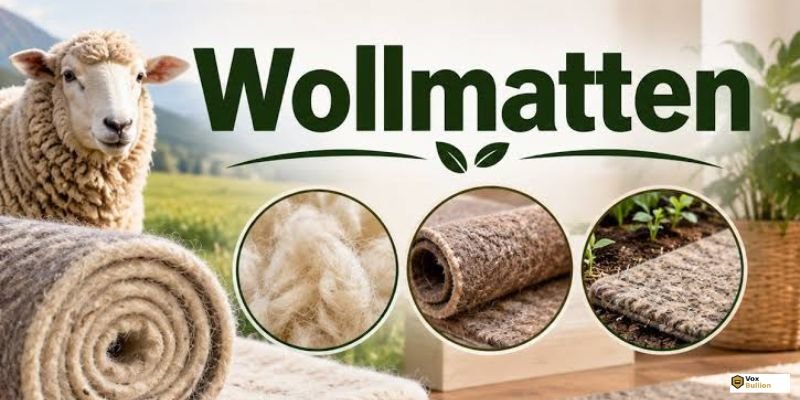
Wollmatten are known to be made with processed sheep’s wool. Raw wool is cleaned and processed after it is sheared. The wool is then rolled or matted to be used in construction. Other agents or treatments may be used by the producer or product to achieve a desired result, like insect protection or stability.
Insulating with sheep’s wool is not new, as everybody is aware that a variety of small spaces are generated in wool, which trap lots of air, and stagnant air is not a good conductor of heat. Thus, building elements insulated with wool have an advantage in reducing heat transfer loss.
Just like a woolen sweater which insulates the body on a cold morning, insulating materials made of wool can serve the same function in building construction.
In addition to being a good insulating material, one of the striking features of wool is that it is a flexible material. As such, an irregularity in a building structure, for example, an open space in timber framing, can be effectively covered.
Temperature Control and Thermal Performance
I like to look at thermal conductivity (also known as lambda value) when assessing different insulation materials. Generally speaking, the lower the thermal conductivity of a material, the better insulator it will be.
Sheep’s wool insulation can also be a good insulation material from a thermal performance perspective, but I definitely can’t depend on a generalization like “wool is a good insulator” in a project. The manufacturer’s technical data should be the main source of information when doing project planning. Thickness will also play a role.
A good insulation design can’t be replaced with a thin layer of a given material just because that material is natural. Factors that play a role when determining the right thickness are the desired performance of the building, the local building code, and the exact product being used. Vague, general building practices are replaced with good, specific building practices for a reason.
Moisture, Sound, and Indoor Comfort
This part of wollmatten is really interesting. Sheep’s wool has fibers that are hygroscopic, meaning that they can absorb water from humid air. So woolen fabrics can also absorb humidity from the air and release it later when the air conditions change.
Why should we care?
Imagine a bedroom with closed windows. Humid air from many hours of sleeping has made the walls wet. If we use materials that can temporarily absorb some amount of humidity in a building, we can improve the indoor climate.
There are, however, a few important distinctions.
Regulating moisture means that the material has the capacity to absorb and release water vapor. This is not the same as being water-repellent. Wool can’t stop the persistent moisture from a wet wall or a leaking roof. Other factors such as airtightness of the building and condensation still need to be considered.
Also, there is evidence that wool absorbs sound and improves the acoustics. Because of the fiber structure, sheep’s wool can also be used for acoustic insulation. This property also justifies considering acoustics when designing and building interiors, as many people have, unfortunately, experienced what it’s like to live next to a sheep’s wool-insulated drum room.
Does Wool Improve Indoor Air Quality?
The main protein in sheep’s wool is keratin. Keratin fiber has been shown to produce bonded structures when interwoven, similar to textile weaving. These structures have been shown to capture and bind formaldehyde and other volatile compounds found in homes and offices. This tells us that wool has purifying properties.
As an air pollutant barrier, wool is much more effective than cotton. The existence of this barrier, however, does not necessarily give us reason to insulate our homes with wool and other textiles purported to “clean the air.” “It purifies the air” is an afterthought benefit.
From a sustainable development perspective, insulating with wool is better than using other raw materials that are based on fossil fuels, but we must expand this perspective to other processes involving the production of the final product. The use of “natural” materials does not always ensure “sustainable” development. The production and transport of the final product must support the goal of promoting the use of “natural” products. The debate on the use of “natural” materials is far from resolved.
Where Can Wollmatten Be Used?
Wollmatten is a flexible form of insulation that has numerous applications. One of these is constructing roofs where the insulation needs to be inserted between the rafters. Wool mats can also be used to insulate floors and ceilings as well as walls and other cavities.
Because of the irregular shapes and sizes found in old buildings during restoration, flexibility is very important. Old buildings often have strange features, such as irregular corners, unusual spacing, mismeasurement, and unevenness.
Flexibility in a mat can be more efficient than using a product with rigidity to fit in irregular spaces. These mats can also be cut to size. It is important to use the correct insulation for the situation. The entire building needs to be considered.
The same principles used for evaluating the insulation of building walls also apply to the floor and roof. Careful consideration of the design, as well as the product and construction, can assist in using the insulation material of choice.
A Small Renovation Lesson I Still Remember
I once spent an entire day doing what should have been a routine insulation job. The timber framework proved to be a problem. Measurements on the plan looked simple. As you know, the measurements in a plan are all that is usually provided.
In the real world, some of the beams were not truly vertical, and one was thinner at the top. Worse still, a thick multi-trade pipe was right where it was least wanted. Cutting rigid board insulation around the pipe was by no means the worst part of that job. Worse was measuring the distance between obstructions and hoping that the insulation could be cut to size.
Thermal values of insulation materials are important. Equally important are the physical characteristics that determine how easily a material can be manipulated to conform to the details of a structure. Flexible Wool has this quality.
There is a limit to how much poor workmanship can be overcome by using a flexible material. I prefer to spend additional time getting a section of workmanship right than to cover it and hope no one notices, because they usually do notice.
Advantages and Disadvantages You Should Consider
The appeal of wollmatten is not just that wool is a renewable resource. For me, such a combination of traits is more convincing than any single environmental claim.
They can provide thermal insulation and yet be flexible enough for a lot of framed structures. Another important feature is their moisture buffering property. The fibrous material can also aid in acoustic insulation. Sheep’s wool is a viable option for anyone interested in natural building materials, not a novelty.
The material is soft and malleable, so installation may be a little more approachable. This is especially handy when you have weird framing. There are, however, drawbacks.
Raw wool is susceptible to pests such as clothing moths, so it is important to prevent pests. So commercial insulation products need to be protected accordingly, and I would always check to see exactly how the manufacturer does this.
Another issue is the fire performance. Sheep’s wool is not to be confused with non-combustible mineral insulation. The stated fire rating of the individual product becomes particularly important in cases where there are strict requirements under building regulations.
And then there is price. Natural insulation options aren’t necessarily the cheapest per m2. When you make an apples-to-apples comparison,n you need to consider not only the purchase price but the required thickness, installation, durability, purpose and the overall needs of your project.
Sheep’s Wool, Mineral Wool, Wood Fiber and Cellulose
I get this question often: “What is the best insulation material?” Personally, I don’t think this is the right question to ask.
What is the objective measurement for “best?”
There are lots of building insulation materials. One of the more common materials is mineral wool. Wood fiber materials can be found in other building systems. There are benefits to using cellulose for blown-in applications as well.
Of the building insulation materials, there are many advantages of sheep’s wool: elasticity, adapting to changes in moisture, renewability and others.
There is no “natural” vs. “conventional” materials debate that I will participate in. Building physiology is the main concern here.
Things like necessary thickness and moisture behavior go hand in hand with fire performance and thermal/acoustic insulation. The same goes for the environment, cost, and other concerns.
There are instances where wool is the best material for the job and should be used. It is good that this is the case because it means we are looking at many objective factors for building insulation and not subjective factors for loyalty.
What should you pay attention to when buying Wollmatten?
I would study the technical documentation before I would buy Wollmatten. I would study it far more closely than I would study the advertisement.
To begin, consider the required thickness of the Wollmatten and the level of thermal conduction. These will help you determine if the Wollmatten will meet your insulation needs. Consider as well if Wollmatten will be used to insulate an internal acoustic partition. The requirements for Wollmatten used to insulate a roof would differ from Wollmatten used for a partition.
I would also consider the density of the Wollmatten. Other factors would include the size, the fire and insect-resistant ratings, additives, the eco-certifications, and the recommendations of the manufacturer regarding the control of moisture.
Pest control would be a consideration as well. If the Wollmatten meets your requirements for its impact on the environment, it would be reasonable to expect that the manufacturer would take the same care to ensure that the other components of the Wollmatten meet your requirements for health and safety as well.
While it would seem that the manufacturer has no legal requirement to provide accurate or complete information, it is in the manufacturer’s best interest to state the facts in a truthful and clear manner. It is better to market a product with honest nd accurate information than pretty pictures.
Yes, a technical data sheet explains the manufacturer’s product in plain language. The data sheet, however, often details the things that are most expensive and most time-consuming to correct. Reading the data sheet can be time well spent. Some important specifications will help you avoid an expensive error.
Correct Installation of Wool Insulation
The quality of installation defines the level of excellence of insulation. Insulation material can only perform to its optimal level if it is properly installed.
Depending on the space you are insulating, ensure the insulation mats are measured and cut to the size needed. Take into account all obstructions, including rafters, studs, corners, cables, pipes, windows and other openings. Once insulation mats are installed, they should be secured using tie strips.
Walls should be insulated to reduce air infiltration. Vapor barriers, or other systems, may be necessary depending on the building and construction conditions and the climate. Condensation control and other building code requirements should be addressed during design and construction.
For small interior projects, some individuals may be comfortable using wool insulation. For exterior projects, especially roofs and walls, condensation control and building code requirements should be addressed by a building expert.
Also Read About: RD Escapement: Best Exhaust, Performance & Fitment Guide
Are Wollmatten Worth Buying?
I think wollmatten are a great insulation option for people who want a material that’s flexible, primarily made from renewable natural resources, that also has on-board moisture management and positive acoustic properties.
They are useful for a variety of different applications such as insulating wood frame walls and roofs, and other irregularly shaped interior walls and ceilings. Flexibility is important for those applications. While I would agree that the use of natural materials is a good thing, I would weigh other factors more heavily.
Count the numbers. Those other factors could include thickness of the material, fire protection, pest protection, the type of product, certifications, cost, and how it fits with the overall building construction. Consider these and similar factors for other insulation products like mineral and cellulose wool, hemp and wood fiber products.
Would I use sheep’s wool insulation for the renovation of my own house? Absolutely. In fact, I would use it for the renovation of a timber house. However, I would be sure that the insulation product is suitable for the building construction, not simply pick the product with the best design story. In the end, it’s the product that fits the building the best that is the right one.
FAQs
How good are wollmatten as insulation?
The actual thermal performance is a function of the specific product, density, thickness,s and installation. Wool from sheep can provide useful building insulation. Still, when calculating or comparing performance, I would always use the claimed thermal conductivity from the manufacturer rather than a generic number for wool.
Is sheep’s wool insulation hygroscopic?
Yeah. Wool fibers are hygroscopic, i.e., capable of absorbing moisture from humid air and releasing it again when the conditions change. This can help with moisture buffering in a well-built building. But don’t think of wool insulation as a remedy for a leaky roof or constant dampness.
Do moths like wool insulating mats?
A reason for pest prevention being a key factor when considering building insulation is that wool is susceptible to particular insects. I urge that you investigate how the specific product is protected, what ingredients or processes are involved, and if the maker has clear technical information on long-term protection.
Is sheep’s wool insulation safe in a roof?
It may be suitable for roof applications when the product used is approved for that use, and the roof assembly is properly designed. Thermal needs, moisture management, airtightness, fire standards, ventilation when applicable, and manufacturer instructions must be taken into account.
Is wool insulation better than mineral wool?
Neither material is better overall. Advantages such as renewable raw material, flexibility, and moisture-buffering features are advantages of wool, whereas other advantages such as strong fire performance are advantages of mineral wool. I would choose based on building requirements, price, installation method,d and technical characteristics rather than just the name of the material.
View More: voxbullion.com